It's now the first week of June, and we are finally starting to see some easing with the lockdown. We are entering "stage two" in Maryland. I am not real clear on what that will entail, but I do know that I will be able to receive Jesus on Sunday, for the first time in months! I am so excited! I am going to dress up! 😊
Other than that things around here aren't much different. I have been to visit a couple of friends, and the guys are getting out to see their friends more often.
Tim is still working from home, but we have a good schedule worked out for the use of the office room in the basement.
The weather has been hot for the last few days, and last night we had a rip-roaring storm!
It was nice for the plants!🌷
I have done very little in the gardening department, but I am maintaining the areas around the house.
I have been mostly working on stuff indoors.
Nina and Lilly are heading out to PA tomorrow morning for a sheep show.
Lilly has worked hard on her lambs.🐑
Cecil County Fair has been cancelled, but they are hoping for some independent shows.
Nina has a new heifer, Delilah. She is a very pretty little thing. She is also a pretty tough little thing.
Hope they get a halter on her soon.
Nina and Delilah
Lilly and Tansey
I guess I will be driving to Texas sometime in August. I had hoped to be heading down there much sooner, but the Covid problem is still pretty bad in the states that I would have to drive through, so I am not going to try until it has more time to settle down. The cities are also pretty unstable right now due to the protests that are going on. Most of them are peaceful and are kept in check by the participants, but some of the bigger cities are being looted and burned, and I would be traveling alone, so I guess waiting is the best plan.
I have been trying to get out for a walk every day, just to have time to pray the Rosary and listen to a podcast or two, but man, it's so hot today!
Maybe tomorrow will be better.
I am praying for a better month in June. So far 2020 has been a handful.
[W]hen people begin to talk about this domestic duty as not merely difficult but trivial and dreary, I simply give up the question. For I cannot with the utmost energy of imagination conceive what they mean. When domesticity, for instance, is called drudgery, all the difficulty arises from a double meaning in the word. If drudgery only means dreadfully hard work, I admit the woman drudges in the home, as a man might drudge [at his work]. But if it means that the hard work is more heavy because it is trifling, colorless and of small import to the soul, then as I say, I give it up; I do not know what the words mean…. I can understand how this might exhaust the mind, but I cannot imagine how it could narrow it. How can it be a large career to tell other people's children [arithmetic], and a small career to tell one's own children about the universe? How can it be broad to be the same thing to everyone, and narrow to be everything to someone? No; a woman's function is laborious, but because it is gigantic, not because it is minute. I will pity Mrs. Jones for the hugeness of her task; I will never pity her for its smallness." ~G.K. Chesterton
I have been looking for this to post. It's one of my favorite quotes. H/T to Laura!
There are so many reasons why we say "Boy, am I glad we Homeschool".
Most of those reasons are positive. We love being able to help each of the boys learn to the best of their ability in their own way. We love being able to take off and go on field trips or vacations when we are studying something interesting. We love being able to choose challenging curriculum, that is tailored to each particular learning style. We love being able to work one on one and watch the way these fabulous minds spark and catch fire. There are so many positive reasons to do what we do, that we frequently forget about the other reasons....the negative ones.
In our homeschool there are no bullies, and no one is allowed to belittle or demean another person. That doesn't mean that it never happens, but it does mean that we do not tolerate it.
In our homeschool there are no school shootings, no knife attacks, no beatings, and no one is allowed to be disrespectful of the teacher. It really helps that we love each other so much, but I have noticed that the boys seem to be carrying these lessons out into the world.
In our homeschool there is absolutely no fear for personal safety. Each and every one of my boys knows that we love and respect every part of each of them; mind, body and soul, and that they should love and respect the minds, bodies and souls of others. We are very careful about where they go and who they are with, and we have an open line of communication that we hope they will always feel free to use.
In our homeschool there is no condescension and no mental abuse.
I am not saying that our school is perfect, far from it. We struggle. We are always concerned about whether we are doing the very best. I try to make sure that they all know that I am mom, and not just teacher. I think and pray about our direction, and I am constantly trying to evaluate my own performance. The reason I am so concerned is because I love my kids so much and I want more than anything to see them become capable and happy adults. I want them to be able to do anything in this world that they decide they want to do. I know them and I love them more than anyone else does, well, with the exception of God and their dad!
We are so blest to have the right to choose the educational direction that we believe is best for our family. There are people that don't agree that we should have this right. For many reasons these people feel that parents are not competent to teach, not trained in the formal processes of education.
Recently it came to my attention that the High School in the town that we call home, our small city by the bay, has been the center of a very hot controversy in the area of parental rights.
Parental rights are something that I hold very dear. The right to raise our children the way we believe best has always been one of the greatest rights and responsibilities that we have in our American Culture. There are those, in our own country and in international circles, that believe that parents are not the best people to decide what their children should learn, believe, or be exposed to and when. There are actually people out there who believe that in parenting, the parents must prove their fitness and that most parents are less than capable of knowing what is best for their children.
In the case of our High School it has become apparent that when children are at school, during school hours, the administrators and staff believe that they have authority over all that the young people see, hear and experience, and that, for those hours, parents are not the primary caregivers of their children.
The issue involves a now-controversial program that the school has been using to reach young people that may be facing serious mental health issues, with the hope that they would be encouraged to seek help. Help that is available through the school. The name of the program was Drama Therapy, and it is actually a proven method of therapy within a certain framework of treatment or diagnosis. "Drama Therapy" itself isn't the problem.
I have gone to a screening and viewed the content, and while it was not in any way wholesome, it would probably fit the Drama Therapy parameters, if there were actual therapists present and participating. It seemed to me that it was students treating students..but that is another story... If you want to read more about it, including excerpts from the plays, you may read about it here.
The problem arose when some of the parents of the young people that attended the mandatory assembly, where this program was performed, heard that it had been done without any parental or even administrative involvement. No parents were informed that it would be taking place. There was no chance for anyone to review the scripts or opt their kids out of the program.
This was a HUGE oversight on the part of the administration. Looking back they can see the errors and the potential for problems in the way that it was handled, but there is no excuse for the way that the families that came forward to express and uphold their rights as parents were vilified and disregarded.
The program was put on by a group of very well-meaning people, who had the kid's best interests at heart. We have the right to protect our children from "well-meaning" people.
The program was put on to help the kids find direction and inspire an environment of openness. We have the right to direct our children and to protect them from an environment that we feel may damage them.
The program may have been intended to put into play the values that the organizers felt the children need to be focusing on. We have the right to define the values and help to inform the consciences of those children in our care. There was no direction, no lessons taught by anyone in authority.
People in this country have been sold a bill of goods by the nanny state.
They believe that only "professionals" are capable of knowing what is best for their families, for their health, for their futures.
Who are these professionals? Do they have it all together? Do they know whereof they speak?
We have the right to know what is going on in our kids classrooms, and we have the right to say that we do not approve.
We have the right to say that there is an objective moral absolute and that we expect our educators, leaders, politicians and government to live up to it.
We have the right to be appalled at the lack of rigor in our school systems, the dropout rate, the illiteracy, the tenure system that keeps incompetent teachers and professors in their jobs.
We have the right to expect to be listened to when it comes to the health and well being of our kids!
Not everyone can homeschool. Most don't want to. They shouldn't have to!!
I am so glad that we can... I am so grateful that we have the laws that we do in this country. Many people have worked very, very hard to make sure that we continue to have this right. There are those that would strip it away.
We need to be aware of the attempts to remove parents as the primary authorities in their kids lives. We need to elect people that will respect and uphold those rights. Do some research. If you can't get a straight answer from a candidate on this issue, then look elsewhere. Find out if they will oppose the United Nations Convention on the Rights of the Child, which will put parents directly under the thumb of the UN.
Go to ParentalRights.org and read about what needs to be done and who is working on it.
There is only so much time, your kids only have one childhood...
On May 28, 2009 USA Today published a story based on a report from the National Center for Education Statistics (NCES), which is part of the Federal Department of Education, titled “The Condition of Education 2009.” The headline of the USA Today story was “Profound shift in kind of families who are homeschooling their children.” A few days later the title was changed to “More higher-income families are homeschooling their children.”
Regrettably, among other problems with the article, USA Today made one blatant error and one very misleading claim. The blatant error is USA Today’s statement that homeschoolers are increasingly white. We do not understand how USA Today can reach this conclusion. Simply by reading the NCES report you will discover that the estimates for white homeschoolers, as a percentage of the entire homeschool population, were 75.3% in 1999, 77% in 2003 and 76.8% in 2007. The obvious conclusion is that for the years 1999–2007 white homeschoolers consistently represented just over three-quarters of the homeschool population.
HSLDA asked the NCES to comment on the USA Today article. Below is a statement from JoAnn Webb, a spokesman for the NCES, “The percentage of all homeschoolers who are White, non-Hispanic has not changed over this period (in the mid-70 percent range).”
Another misleading claim, as the revised title for the story states, is that more higher-income families are homeschooling their children. Again, USA Today failed to correctly read the report. In order to make their point, USA Today defines “higher-income” as families whose household income is over $50,000. How many people really consider $50,000 in household income “higher-income?” For comparison, according to the U.S. Census Bureau, in 2006 married-couple families with one or more related children under age 18, the median nationwide income was $74,049. It is very misleading for USA Today to boldly assert that more “higher-income” families are homeschooling when out of the 60% of families they cite as being “higher-income” — (26.8% in the $50,001–$75,000 bracket and 33.2% in the $75,001 or more bracket) the 26.8% that USA Today believes to be “higher-income” actually have below average incomes.
Also, as has been confirmed by the NCES, the income figures between 1999 and 2007 were not adjusted for inflation. This means that the same type of person answering the NCES survey in 1999 that fell in the $25,001–$50,000 income bracket could easily find themselves in the $50,001–$75,000 bracket in 2007 since an income of $45,000 in 1999 becomes $55,518.63 in 2007 after adjusting for inflation.
It’s a shame that in an era when hundreds of diverse media outlets are able to accurately report on the homeschool movement a major newspaper has made such simple errors.
Perhaps the writer was just in a rush to be first, since his story was published on the day the NCES report was released online, or perhaps he has an agenda to falsely paint homeschoolers as rich and white, thereby dismissing the full range of people who are making tremendous sacrifices on limited budgets to ensure that the next generation receives the best education and upbringing available. Either way USA Today should make additional corrections to their factually inaccurate story.
Here is a link to the Website of author William Forstchen. He is a really interesting guy and the information on Electro Magnetic Pulse effects is really worth reading. I am going to try to find the book at the library. An exciting Summer read, if nothing else.
Given our massive debt load, this fictional apocalyptic scenario’s not looking that bad.
“ ‘Hey, Dad, something strange.’
“ ‘Yeah?’
“ ‘Listen.’
“He stood there silent for a moment. It was a quiet spring evening, silent except for a few birds chirping, the distant bark of a dog . . . rather nice, actually.
“ ‘I don’t hear anything.’
“ ‘That’s it, Dad. There’s no traffic noise from the interstate.’
“He turned and faced toward the road. It was concealed by the trees . . . but she was right; there was absolute silence. When he had first purchased the house, that had been one disappointment he had not thought of while inspecting it but was aware of the first night in, the rumble of traffic from the interstate a half mile away. The only time it fell silent was in the winter during a snowstorm or an accident . . .
“ ‘Most likely the accident’s further on and people were told to pull over and wait,’ he said.
“The girls nodded . . . It was almost eerie. You figure you’d hear something, a police siren if there was indeed an accident, cars down on old Highway 70 should still be passing by.
“And then he looked up. He felt a bit of a chill.
“This time of day any high-flying jets would be pulling contrails . . . ”
But there aren’t any contrails, or jets. It’s America “one second after,” to use the title of William R. Forstchen’s novel.
One Second After what? After an EMP attack. What’s EMP? “Electromagnetic pulse.” You’re on a ship hundreds of miles offshore floating around the ocean, and you fire a nuke. Don’t worry, it doesn’t hit Cleveland, or even Winnipeg. Instead, it detonates 300 miles up in the sky at a point roughly over the middle of the continent. No mushroom cloud, no fallout, you don’t even notice it. That’s the “second” in One Second After and what comes after is America (and presumably pretty much all of Canada south of Yellowknife) circa 1875—before Edison. The cars on the interstate stop because they all run on computers, except for Grandma’s 1959 Edsel. And so do the phones and fridges and pretty much everything else. If you were taking a hairpin bend when your Toyota Corolla conked out, don’t bet on the local emergency room: they’re computerized, too. And, if you’ve only got $27.43 in your purse, better make it last. The ATM won’t be working, and anyway whatever you had in your account just vanished with the computer screen.
Mr. Forstchen tells his tale well, putting an up-to-the-minute scientifically sound high-tech gloss on an old-fashioned yarn. One Second After is set in small-town North Carolina, but the stock characters of Anyburg, U.S.A. are all here—the sick kid, slow-on-the-uptake local officials, gangs of neo-barbarians, the usual conflict between self-reliant can-do types and the useless old hippies. I liked this passage:
“ ‘What a world we once had,’ he sighed.
“The parking lot of the bank at the next corner was becoming weed-choked, though that was being held back a bit by children from the refugee center plucking out any dandelions they saw and eating them.”
And at that point I stopped thinking of One Second After as a movie-thriller narrative, and more in geopolitical terms. After all, the banks in America and western Europe are already metaphorically weed-choked, and may yet become literally so. In the Wall Street Journal a couple of months back, Peggy Noonan predicted that by next year the mayor of New York, “in a variation on broken-window theory, will quietly enact a bright-light theory, demanding that developers leave the lights on whether there are tenants in the buildings or not, lest the world stand on a rise in New Jersey and get the impression no one’s here and nobody cares”—or, to put it another way, lest the world stand on a rise in New Jersey and get the impression Manhattan’s already been hit by an EMP attack. A friend of mine saw his broker in February and asked him where he should be moving his money, expecting to be pointed in the direction of various under-publicized stocks or perhaps some artfully leveraged instrument novel enough to fly below the Obama radar. His broker, wearing a somewhat haunted look, advised him to look for a remote location and a property he could pay cash for and with enough cleared land and a long growing season. My friend’s idea of rural wilderness is Martha’s Vineyard, so this wasn’t exactly what he wanted to hear.
And this is before EMP hits.
So it wipes out your bank accounts. What’s in there? I mean, really. The average American household is carrying $121,953 in personal debt. What would be so bad if something goofy happened and all the meters got reset to zero? And Joe Schmoe’s credit card debt is as nothing compared to what the government’s signed him up for: USA Today recently calculated that the average American household is on the hook for $546,668 in federal debt—i.e., not including state and municipal. The Atlantic crunched the numbers further and reckoned that, to pay off the federal/personal debt over half a century at three per cent, the average household would have to write an annual cheque for $25,971. U.S. median household income is 50 grand, before taxes—and that $26,000 cheque assumes no further increase in federal or personal liabilities.
As news of the murder of an infamous abortion practitioner hit the internet today, many, many pro-life groups, blogs, and leaders condemned this act of cowardice. It has set back the hard work of so many credible people.
I am hoping, as I write this, that the killer turns out to be somebody who is just totally outside the circle of rational, hard-working pro-life people. This is not the behavior of someone who values life from conception to natural death, obviously.
George Tiller was easy to vilify, he did heinous things to innocent people, but he has an eternal soul. That is the saddest thing of all. This killer took away Tiller's chance to change his heart, ask forgiveness, and possibly become a force for good in the battle against abortion.
Bernard Nathanson is one example of a doctor who was a leader in the abortion industry and finally saw the work he was doing for what it was. He has done SO much for the pro-life movement. People believe him. The people who have done the most awful things need the most time!
We will pray for the pro-life movement, for the souls of all those involved, and for the soul of George Tiller. We are pro-life, it's what we do.
FOXNews.com Ten Years Later, Boy's 'Hand of Hope' Continues to Spark Debate
Wednesday, May 06, 2009 By Joshua Rhett Miller
Nearly 10 years after a stunning photograph of his tiny hand traveled the world, Samuel Armas has a firm grip on what "The Hand of Hope" means to him.
"When I see that picture, the first thing I think of is how special and lucky I am to have God use me that way," Samuel told FOXNews.com. "I feel very thankful that I was in that picture."
On Aug. 19, 1999, photographer Michael Clancy shot the "Fetal Hand Grasp" — his picture of a 21-week-old fetus grasping a doctor's finger during innovative surgery to correct spina bifida. Nearly four months later, on Dec. 2, Samuel Armas was "born famous."
The photo, which first appeared in USA Today on Sept. 7, 1999, quickly spread across the globe as proof of development in the womb and was later cited during congressional debates on the Partial-Birth Abortion Ban Act, which passed in 2000.
"It's just a miracle picture, a miracle moment," Clancy told FOXNews.com. "It shows the earliest human interaction ever recorded."
Al Qaeda's 'Vanity Fair' Targets Americans for Jihad Training
It's been called Al Qaeda's "Vanity Fair," a new English-language Internet magazine called "Jihad Recollections" that focuses on the terrorist group, its founder, Usama Bin Laden, and how to commit jihad. It also predicts the demise of the United States.
“This is designed for Americans,” says noted terrorism expert Steven Emerson, founder of the Investigative Project on Terrorism in Washington, D.C., and author of the book "American Jihad: The Terrorists Living Among Us."
The proportion saying that abortion should be legal in all or most cases has declined to 46% from 54% last August. The decline in support for legal abortion has come entirely in the share saying abortion should be legal in most cases (from 37% to 28%); 18% say abortion should be legal in all cases, which is virtually unchanged from last August (17%). Currently, 44% say abortion should be illegal in most (28%) or all cases (16%), up slightly since last August (41%).
What has caused the change? My guess: people who have been made aware of what partial birth abortion is cannot tolerate it. I'd be interesting to see how many people learned about partial birth abortion during the election cycle when pro-life groups began bringing up the point that Obama supports it. There still remains a small minority (18%) who are abortion absolutists, and a small minority (16%) who are completely pro-life. But now only 28% of people say abortion should be legal in "most cases" - down from 37%! What do you think has caused this change?
Do note this: the poll claims 46% of Americans support abortion in some or all cases, while 44% oppose it in some or all cases. This means that the claim "American is a pro-choice country" is simply false. America is a deeply-divided country about this issue. Within the margin of error, in fact. Belief in abortion is far from "common" sense. It is not commonly held. This means that Obama's position on abortion only identifies him with 18% of the American people.
Pew has more details on the poll here, once you scroll down the page.
Laura put me onto the THIS blog, and as I was reading along, enjoying myself, and thinking about how nice it is to find like-minded folks out there in the blogosphere, I stumbled onto this post. Coming from the Pacific Northwest, I already knew that the "battle to save the trees" has all the liberals in a blind panic. Every time someone reminds me to cut down on paper and save a tree, I want to reply "What? You're eating a sandwich? Don't you care about the Wheat!?". ARRGGGHHH! If you like this, go to "Change Barack!" and read the rest of the reasons.
One of my political mantras is: Capitalism Solves Everything.
(For those of you who don't recall, Capitalism was an economic system practiced in the United States from the founding of the nation up until late 2008 to early 2009.)
The full explanation of this phrase is for another post, but suffice it to say that I believe that capitalism would solve environmental problems if it were allowed to function to its full potential.
The problem with the way many environmentalists go about protecting the environment is that they do so by attacking capitalism. So, like any sane person, I am totally in favor of protecting the water supply and having breathable air, I simply do not believe that more government involvement is the answer.
Nor do I believe shutting down big businesses by legal force or though borderline terrorist acts (I'm looking at you ELF), are viable solutions.
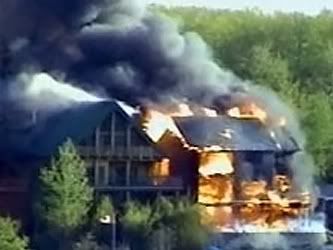
ELF torched this home. Burning stuff for the environment. Yeah, you're not crazy.
You want people to embrace environmentalism, allow the free markets to work, and amazing things will happen.
Mature trees, like all living things, metabolize more slowly as they grow old. A forest of young, vigorously growing trees will remove five to seven tons more CO2 per acre than old growth. There are plenty of good reasons to preserve old growth forests, but redressing the CO2 balance is not one of them. If we were really interested (as we should be) in reducing atmospheric CO2, we should be vigorously pursuing reforestation and the planting of trees and shrubs, including in urban areas, where local impacts on the atmosphere are greatest. "Reforestation has been going on through enlightened forestry practices on private lands by timber companies and as a result of changes in agricultural and land use. In the United States, the average annual wood growth is now more than three times what it was in 1920, and the growing stock has increased 18 percent from 1952 to 1977. Forests in America continue to increase in size, even while supplying a substantial fraction of the world's timber needs."
(Dixy Lee Ray with Lou Guzzo, Trashing the Planet, (New York: Harper Collins, 1990), p. 36.)
Why is it that logging companies exist? I know the primary reason is to utterly decimate miles and miles of land and destroy the atmosphere by removing our only source of oxygen. But the secondary reason logging companies exist is to make money.
If you only had 100 head of cattle, would you kill them all for money right away? Of course not. You would breed them first in order to be resupplied with the raw materials which you produce. Logging companies are not bent on the destruction of forests, they are bent on the creation of large bank accounts. This is done through the miracle of capitalism and the foresight of capitalists to plant new trees and allow them to grow as you cut down the mature trees thereby creating a source of income for the future.
By capitalism we get the benefit wood products and an ever-growing supply of oxygen-rich air.
So, on this 39th Earth Day take a deep breath and thank capitalism for providing this priceless commodity of breathable air at no charge!
Oh and "carbon off-sets" are a stupid idea, but God bless the capitalist who sells them to environmentalist suckers.
The End of the World as We Know It Welcome to the “post-American era.”
By Mark Steyn
According to an Earth Day survey, one third of schoolchildren between the ages of six and eleven think the earth will have been destroyed by the time they grow up. That’s great news, isn’t it? Not for the earth, I mean, but for “environmental awareness.” Congratulations to Al Gore, the Sierra Club, and the eco-propagandists of the public-education system in doing such a terrific job of traumatizing America’s moppets. Traditionally, most of the folks you see wandering the streets proclaiming the end of the world is nigh tend to be getting up there in years. It’s quite something to have persuaded millions of first-graders that their best days are behind them.
Call me crazy, but I’ll bet that in 15-20 years the planet will still be here along with most of the “environment” — your flora and fauna, your polar bears and three-toed tree sloths and whatnot. But geopolitically we’re in for a hell of a ride, and the world we end up with is unlikely to be as congenial as most Americans have gotten used to.
As our family grows and matures, I have become more and more aware of the importance of autonomy in the workings of individual families. Every family is different and every child depends on the bonds that are forged within the family to navigate the larger world. Granted, not all children are blest with a family that provides a strong foundation for the future, but, I think that for the most part, American families do want the best for their children and most parents really try to be the best that they can be for their kids.
There is a very different view of family and childhood within the international community. There is a storm brewing for parents and families in this country, and we need to become informed and aware, as parents, grandparents and citizens.
I am going to be blogging about it off and on as this issue unfolds. Please share this information with others, so that we can unify our efforts. The U.N. Convention on the Rights of the Child (CRC) is a sweeping effort by the United Nations to move into our families and determine how parents are able to raise their children. At this time we have signed, but not ratified this treaty. Please inform yourself and get in touch with your people in Congress. Encourage them to support the Parental Rights Amendment.
Here is some information that came from the Parentalrights.org website. I will post new information as it is available.
20 THINGS YOU NEED TO KNOW ABOUT THE CRC
Ten things you need to know about the structure of the CRC.
It is a treaty which creates binding rules of law. It is no mere statement of altruism.
Its effect would be binding on American families, courts, and policy-makers.
Children of other nations would not be impacted in any direct way by our ratification.
The CRC would automatically override almost all American laws on children and families because of our Supremacy Clause.
The CRC has some elements that are self-executing, while others would require implementing legislation. Federal courts would have the power to determine which provisions were self-executing.
The Courts would have the power to directly enforce the provisions that are self-executing.
Congress would have the power to directly legislate on all subjects necessary to comply with the treaty. This would constitute the most massive shift of power from the states to the federal government in American history.
A committee of 18 experts from other nations, sitting in Geneva, has the authority to issue official interpretations of the treaty which are entitled to binding weight in American courts and legislatures. This effectively transfers ultimate authority for all policies in this area to this foreign committee.
Under international law, the treaty overrides even our Constitution.
Reservations, declarations, or understandings intended to modify our duty to comply with this treaty will be void if they are determined to be inconsistent with the object and purpose of the treaty.
Ten things you need to know about the substance of the CRC.
Parents would no longer be able to administer reasonable spankings to their children.
A murderer aged 17 years, 11 months and 29 days at the time of his crime could no longer be sentenced to life in prison.
Children would have the ability to choose their own religion while parents would only have the authority to give their children advice about religion.
The best interest of the child principle would give the government the ability to override every decision made by every parent if a government worker disagreed with the parent’s decision.
A child’s “right to be heard” would allow him (or her) to seek governmental review of every parental decision with which the child disagreed.
According to existing interpretation, it would be illegal for a nation to spend more on national defense than it does on children’s welfare.
Children would acquire a legally enforceable right to leisure.
Christian schools that refuse to teach "alternative worldviews" and teach that Christianity is the only true religion "fly in the face of article 29" of the treaty.
Allowing parents to opt their children out of sex education has been held to be out of compliance with the CRC.
Children would have the right to reproductive health information and services, including abortions, without parental knowledge or consent.
For a full explanation of all of these points, check out Mike Farris's article,Nannies in Blue Berets.
Well Aldous, I hate to be the one to have to say it, but you were wrong. Not totally wrong. Your book was amazingly prophetic where technology and the engineering of humanity is concerned, but the title didn't pan out.
We are not living in a Brave New World, we are living in an increasingly fearful world of those with "knowledge" of "the future" or "science" or "economics" or "whatsgoodforus" bullying those that have to look to the media for information.
What are we afraid of?
We are afraid of CO2.
We are afraid to cut down trees.
We are afraid of babies.
We are afraid of having too many babies.
We are afraid that holding prisoners of a nasty war that they started won't look good to the rest of the world.
We are afraid that having enough food, driving cars, heating our homes, wearing warm clothes, etc., won't look good to the rest of the world.
We are afraid to say NO to our kids.
We are afraid to eat Meat.
We are afraid of the Free Market System of government.
We are afraid of plastic.
We are afraid of being insensitive.
We are afraid of the TRUTH.
We are afraid of ourselves.
When will people inform themselves instead of listening to the voices of gloom and doom? Some of these things are issues that we need to be moderately concerned about. Some of these things are things that we may need to get together and get our heads around, but we have to discern these things for ourselves. We have GOT to get our heads out of the mainstream media! The "AL" Channel, the "Obama" networks, the "Pelosi" Times.
I am willing to concede the importance of any of the issues that Power wails and gnashes it's teeth about, but only after I have looked around to see if there are any plausible arguments to the contrary. We need to form our consciences and intellects around more than the big three networks and the LA Times. The internet is right there. For the moment there is an unlimited wealth of knowledge to be had and authorities on all sides to weigh and measure.
When something as important as the economic stability of our country, or the lives and well-being of millions of people yet to be born is at stake, what is stopping us from taking the time to get the facts and then speaking the Truth BACK to Power? We have the information literally at our fingertips.
What would an informed citizenry mean to this country and our world? They don't want to find out.
WASHINGTON, DC, January 26, 2009 (LifeSiteNews.com) - Celebrated columnist and pro-family leader Don Feder gave a jaw-dropping presentation on the coming 'Demographic Winter' at the Rose Dinner which closes the official March for Life festivities every year. Speaking to hundreds of attendees, Feder suggested that the demographic problem of worldwide declining birthrates "could result in the greatest crisis humanity will confront in this century" as "all over the world, children are disappearing."
"In the Western world, birthrates are falling and populations are aging," said Feder. "The consequences for your children and grandchildren could well be catastrophic."
Feder noted, "In 30 years, worldwide, birth rates have fallen by more than 50%. In 1979, the average woman on this planet had 6 children. Today, the average is 2.9 children, and falling." He explained the situation noting, "demographers tell us that with a birthrate of 1.3, everything else being equal, a nation will lose half of its population every 45 years."
Beyond an inability to pay for pensions, it is likely that euthanasia will be one looked-to solution to the aging crisis, he said.
"Demographic Winter is the terminal stage in the suicide of the West - the culmination of a century of evil ideas and poisonous policies,'" he said. Among them he listed:
"Abortion - As I mentioned a moment ago, worldwide, we're killing 42 million people a year. It's as if an invading army killed every man woman and child in Italy - then repeated the process every year.
"Contraception - For the first time in history, just under half the world's population of childbearing age uses some form of birth control. Some of us remember when births weren't controlled and pregnancies weren't planned. With all the wailing about man-made Global Warming, carbon footprints and the ozone layer, wouldn't it be ironic if what did us in wasn't the SUV but the IUD?
"Delayed marriage. People are marrying later and later. After 35, it becomes progressively harder for a woman to have children.
"The decline of marriage and the rise of cohabitation. Not surprisingly, in relationships without commitment, people have fewer children. By the way, the left's contribution to the coming population crisis is to push the one type of ‘marriage’ (and I use the term advisedly) that can't conceivably produce children.
"But perhaps,” he concluded, “the most important factor is a culture (including Hollywood, the news media and academia) that tells people that children are a burden, rather than a joy; that pushes an ego-driven, live-for-the-moment ethic; a culture that tells us that contentment comes from careers, love, friendship, pets, possessions, travel, personal growth - anything and everything except family and children. It's a culture that can look at Sarah Palin and her beautiful family and ask why she had to have 5 children and why she didn't abort her child with Downs syndrome."
For more see the first documentary on the plummeting birth rate: